The long ideological road from Najaf to Beirut and the killing of Hariri
The long ideological road from Najaf to Beirut and the killing of Hariri
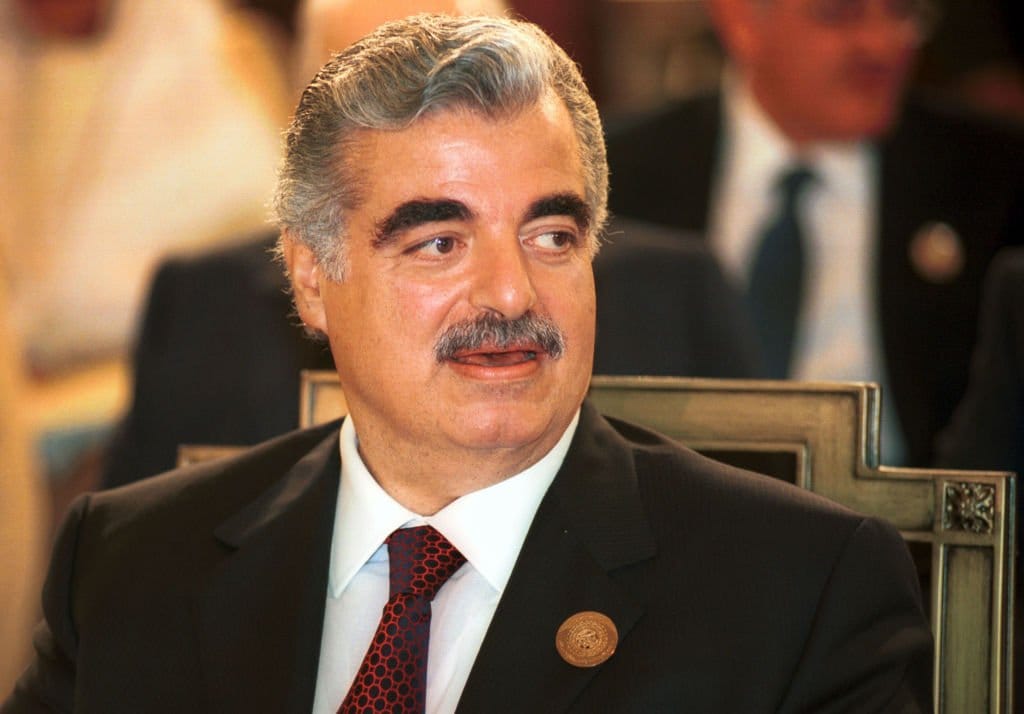
Just over two decades ago, a massive explosion in central Beirut killed 22 people, including the bombers’ target: businessman and reform-minded former Lebanese Prime Minister Rafic Hariri. The political reverberations are still being felt today.
While widely interpreted at the time as the culmination of domestic political tensions, the assassination had a much wider context. Indeed, it can only be understood through a broader historical and ideological continuum.
Hariri, a Sunni Muslim with close links to Saudi Arabia, was both popular and effective. A billionaire, he was instrumental in the signing of the Taif Agreement, which ended Lebanon’s bloody and disastrous 15-year civil war, in 1989.
He was prime minister twice, from 1992-98, and from 2000-04. He defended UN Security Council Resolution 1559, which called for ‘all remaining foreign forces’ to leave Lebanon. This was aimed at Syria. In Damascus, President Bashar al-Assad (who was an ally of Iran) did not take kindly to being asked to leave.
Hariri’s assassination, just five months after he left office as prime minister, was not simply a response to his local influence; it was part of a larger strategic trajectory rooted in decades of Shi’ite political thought and revolutionary activism.
Najaf to Beirut
Events in Beirut, such as Hariri’s killing, in fact had their genesis in the religious seminaries of Najaf (in Iraq, one of the holiest cities is Shi’a Islam) and the revolutionary circles of Tehran, the capital of Iran, where Ayatollah Ruhollah Khomeini and the Revolutionary Guards first sought to export their Islamic Revolution more than 40 years ago.
Hezbollah is the Lebanese local manifestation of Khomeini’s transnational Shi’ite political-religious project inspired, and although Hezbollah is thought to have emerged in response to Israel’s 1982 invasion of Lebanon, it was already in gestation long before then. The invasion was more of a catalyst than a cause.
Pull Quote: Hariri’s killing was part of a larger strategic trajectory rooted in decades of Shi’ite political thought and revolutionary activism
In the 1960s and 70s, Shi’ite clerical circles in Iraq—particularly in Najaf—began to articulate a new relationship between religion and political authority. From this, the Dawa Party, co-founded by Iraqi scholar Mohammad Baqir al-Sadr, sought to integrate Islamic jurisprudence with anti-Ba’athist political activism.
Al-Sadr and others advocated for an activist interpretation of Islam that legitimised political revolution. In this intellectual environment, Ayatollah Khomeini (exiled in Najaf) developed his doctrine of Wilayat al-Faqih, or Guardianship of the Jurist. As outlined in his 1970 book Hukumat-e Islami, Khomeini’s theory argued that a qualified Islamic jurist should wield political authority in an Islamic state.
Pan-Shi’a blueprint
This Guardianship of the Jurist doctrine provided the theological foundation for the Islamic Republic of Iran and served as a blueprint for Shi’ite political mobilisation beyond Iran’s borders. At the same time, Lebanon’s Shi’ite community—historically marginalised both economically and politically—was undergoing a transformation.
Musa al-Sadr, an Iranian-born cleric, was organising the community through institutions such as the Movement of the Deprived and its military wing, Amal. Yet his mysterious disappearance in Libya in 1978 created a vacuum that more radical and ideologically committed clerics (often aligned with Tehran) quickly sought to fill.
By the early 1980s, Iran’s Revolutionary Guards were setting up training camps in the Bekaa Valley and supporting the establishment of Hezbollah, whose foundational document—the 1985 Open Letter—pledged allegiance to Khomeini and affirmed Wilayat al-Faqih as its guiding principle.
This distinguished it from nationalist resistance movements. Instead, it reflected a deeper commitment to a revolutionary, pan-Shi’a framework. By the time Israel invaded Lebanon in 1982, Hezbollah’ ideological framework had already been established, its militarisation had begun, and it was proving to be popular.
The Revolutionary Guards’ support went beyond military training; it was involved in the creation of a parallel political and religious infrastructure in Lebanon that mirrored the Islamic Republic.
Researchers like Augustus Richard Norton and Joseph Alagha have looked at Hezbollah’s dual identity as both a resistance group and a socio-political actor, which helps to show how it cannot be understood merely in response to Israeli actions, but as an intentional outgrowth of a larger revolutionary movement.
Competing ideas
Hezbollah’s vision for Lebanon was at odds with Hariri’s vision for Lebanon. The latter was grounded in neoliberal economic reconstruction, alignment with the West, and cooperation with Arab Gulf states, notable Saudi Arabia (Iran’s longtime foe).
Furthermore, Hariri’s support for UNSCR 1559 put him in direct opposition to Hezbollah and its patrons in Damascus and Tehran. His assassination thus transcended mere political rivalry. Rather, it served a strategic purpose: removing an influential figure whose policies threatened the ideological and geopolitical interests of Iran, Hezbollah, and Syria – aka ‘the Axis of Resistance’.
Pull Quote: The Revolutionary Guards helped create a parallel political and religious infrastructure in Lebanon that mirrored the Islamic Republic
The legacy of Hezbollah’s ideological origins is evident in its enduring alliances across the region, not least with Iraq’s Shi’ite-dominated Popular Mobilisation Forces, Yemen’s Houthi movement, and pro-Iranian militias in Syria. All share a common ideological lineage, adhering to the strategic and theological principles laid out by Khomeini, and all have relied on Iranian support.
This network, or ‘Axis,’ can be seen as a Shi’ite transnational movement, one that has sought to redefine regional power structures through both armed struggle and ideological propagation.
In summary, the events of 2005 is linked to the establishment and trajectory of Hezbollah, which in turn cannot be fully understood without knowing its ideological parentage. Hariri’s killing sits on a continuum that began in Najaf, became institutionalised in Tehran, and found its Lebanese expression in Hezbollah.
Understanding this historical and ideological context reveals that the current conflicts in the region are not merely geopolitical contests, but also wars of ideas shaped by a revolutionary Shi’ite framework that continues to evolve.
__
By: Elie Fawaz is an author whose forthcoming book Iran in the Middle East further explores these ideological currents and their implications for the future of regional politics.