Precision Israeli strike on southern Beirut targets Hezbollah’s number two

Israeli army spokesman Avichai Adraee confirmed Sunday evening the “elimination of Haytham Ali Tabtabai, Hezbollah's chief of staff,” whom he described as a “terrorist,” in an Israeli airstrike that targeted a residential building in Beirut's southern suburbs.
The escalation was described in Beirut as “very dangerous,” coming nearly a year after the ceasefire agreement between Israel and Lebanon came into effect.
Lebanese President Joseph Aoun said “the Israeli airstrike targeting Beirut's southern suburbs is further proof that Israel disregards repeated calls to cease its attacks on Lebanon and refuses to implement international resolutions and all efforts and initiatives aimed at ending the escalation and restoring stability not only to Lebanon but to the entire region.”
Aoun emphasized that Lebanon “has adhered to the cessation of hostilities for nearly a year and has presented initiative after initiative,” reiterating his “call on the international community to assume its responsibilities” and intervene “forcefully and seriously” to stop the attacks on Lebanon and its people. He warned that further escalation risked reigniting regional tensions and causing additional bloodshed.
Israeli media reported that Tel Aviv informed the ceasefire monitoring committee (the Mechanism Committee) that it would not escalate unless Hezbollah retaliated.
In the initial hours following the operation, Hezbollah confirmed only that the Israeli strike targeted “one of its officials,” without providing further details.
Prime Minister Nawaf Salam said that “protecting the Lebanese people and preventing the country from sliding into dangerous situations is the government's priority at this critical juncture. It will continue to work through all political and diplomatic means with brotherly and friendly nations to protect the Lebanese people, prevent any open escalation, and ensure a halt to Israeli aggression, its withdrawal from our land, and the return of our prisoners.”
Approximately four hours after the attack, Adraee posted that the strike “eliminated Tabatabai,” whom he described as “a key Hezbollah operative who joined its ranks in the 1980s and held a series of leadership positions, including commander of the Radwan Unit and Hezbollah's operations officer in Syria. He worked to enhance Hezbollah's capabilities and was a prominent figure in the development of the Radwan Unit. As part of his duties in Syria, he strengthened the terrorist organization's presence there.”
He added that “during the last war between Israel and Hezbollah, Tabatabai assumed the position of commander of Hezbollah's operations system and was responsible for shaping the organization's situation and building its strength. During Operation Northern Arrows, after the elimination of most of the organization's military leadership, he took charge of managing the war with Israel. At the conclusion of Operation Northern Arrows, Tabatabai became Hezbollah's chief of staff, leading the organization's reconstruction efforts and commanding most of its units, working to rehabilitate them for war with Israel.”
The Israeli army spokesman said the military “will act against attempts to rebuild and rearm the terrorist group Hezbollah and will work forcefully to eliminate any threat to the citizens of the State of Israel. It remains committed to the understandings reached between Israel and Lebanon.”
According to initial reports from Beirut, the target was the second-in-command of Hezbollah. His father is Iranian and his mother is Lebanese, and he resided in Lebanon.
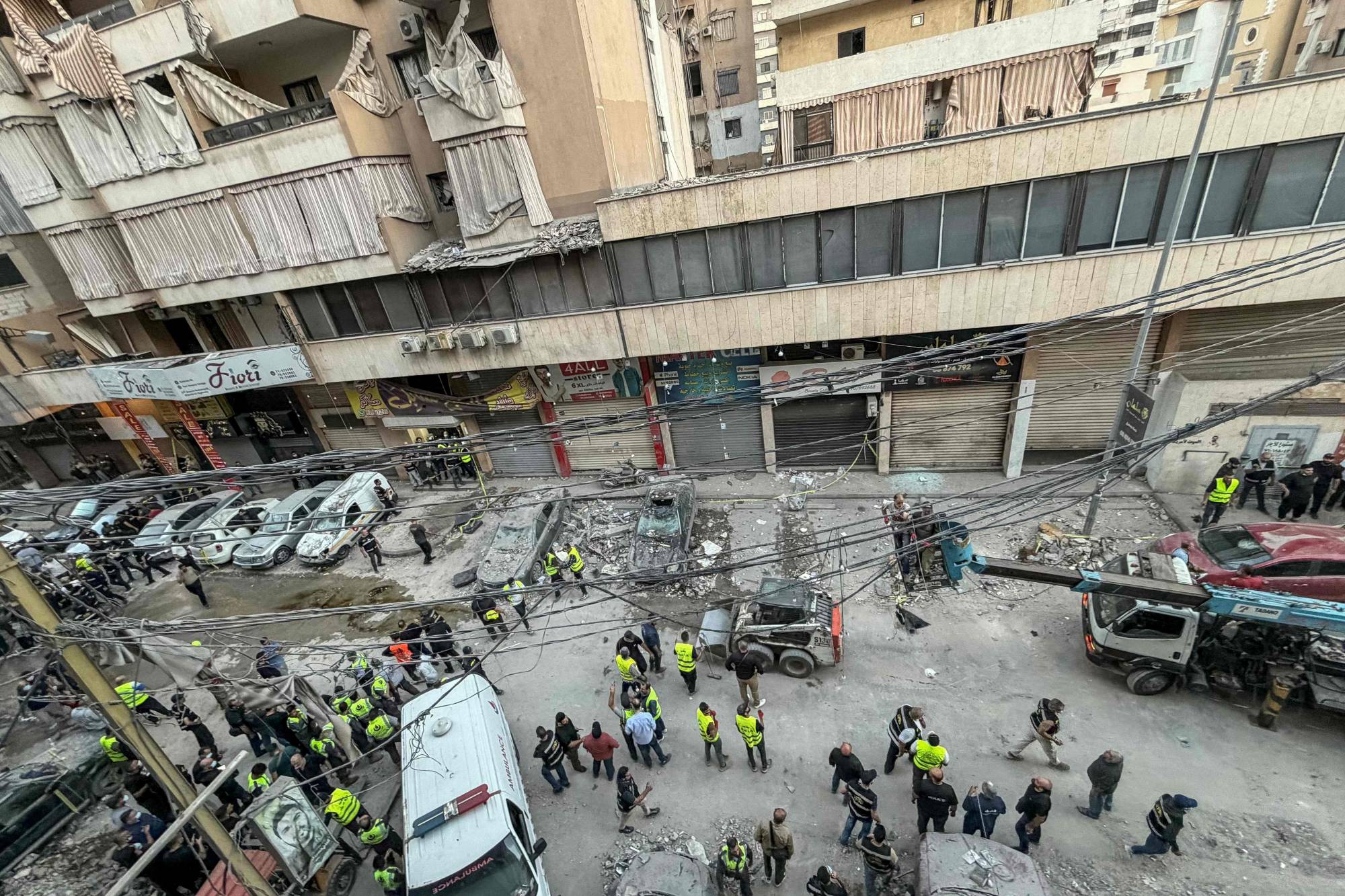
The Lebanese Ministry of Health said the airstrike, which hit several floors of a residential building on Al-Arid Street in Haret Hreik without prior warning, killed five people and injured 28 others.
The Lebanese army imposed a security cordon around the site. Panic swept the neighbourhood, with several families fleeing the southern suburbs for fear of further attacks amid continuous, low-altitude Israeli reconnaissance flights extending as far as Baalbek and Hermel.
The airstrike, described as “precise,” was ordered by Israeli Prime Minister Benjamin Netanyahu based on recommendations from the Minister of Defense and the Chief of Staff, according to Netanyahu's office.
Israeli Channel 12 reported that “Israel attempted to assassinate Tabatabai twice during the war, and this was the third time. The raid against the Hezbollah chief of staff at his hideout in the southern suburbs of Beirut was coordinated with the Americans.”
Three missiles hit the building. Israeli media said they were GBU-39s, “characterized by their high accuracy, light weight, and small dimensions, allowing them to be precisely guided to specific targets and capable of penetrating approximately six feet of reinforced concrete.”
The US State Department had offered a reward of up to $5 million for information leading to the location or arrest of Tabatabai.
According to the department, he commanded elite forces and played a direct role in Hezbollah’s operations in Syria, as well as overseeing special forces operatives who worked in Yemen, activity Washington says contributed to destabilizing regional actions through training, equipment, and expertise. He was designated a “Specially Designated Global Terrorist” in 2016.
The Iranian Embassy in Lebanon said on its social media accounts that “the terrorist Israeli entity does not hesitate to threaten the safety of the dear Lebanese people. These cowardly attacks will not diminish the resolve of those who are in the right, nor will they weaken their unwavering will to confront it.”