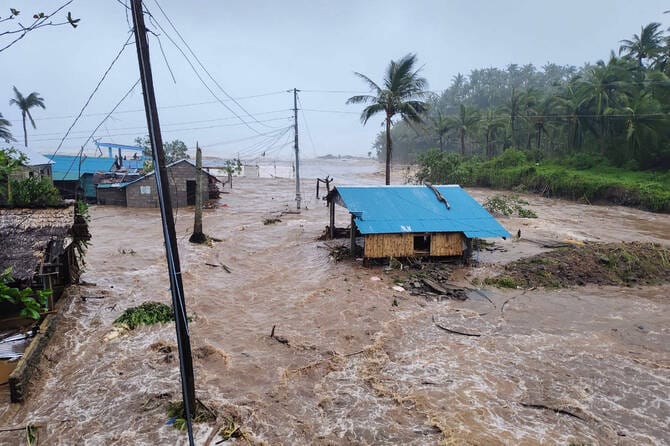
Hundreds more remained missing across Sri Lanka on Monday, as rescuers continued to battle catastrophic flooding and landslides after Cyclone Ditwah, the worst natural disaster to hit the island in decades.
At least 355 people have been confirmed dead by Sri Lanka’s Disaster Management Center, and nearly 400 are missing, with most casualties reported in the Kandy, Badulla and Nuwara Eliya districts in the country’s central mountainous tea-growing regions.
More than 200,000 people are sheltering in 1,500 government-run safety centers, while about a third of the country is without electricity or running water.
Azmi Sheriff from Akurana in Kandy told Arab News that one of the neighborhoods in his area had been entirely buried in mud, and rescuers were struggling to recover the victims.
“One of the worst-affected areas is a place called Rambuke-ela. There has been a severe mudslide, and around 20 houses, or maybe more, were completely destroyed. About 50 people are dead, buried,” he said.
“A few bodies were taken out, but they are finding it difficult to take the other ones.”
Cyclone Ditwah made landfall on Nov. 28, triggering the most severe flooding Sri Lanka has seen since the devastating 2004 Asian tsunami that killed about 31,000 people in the island nation and left hundreds of thousands homeless.
Silmiya Yusuf, a teacher visiting her ancestral village in the north-central district of Kurunegala, was only able to reconnect with the outside world on Monday after the network was restored.
“Thanks to Allah, we are still alive,” she said. “Without any connection to the world, it felt like dark days in everyone’s life. Only now, after seeing social media, I realize how many incidents happened around us.”
President Anura Kumara Dissanayake, who declared a state of emergency on Sunday, said the country was “facing the largest and most challenging natural disaster in our history” and called for international aid.
While the cyclone has since moved back over the Bay of Bengal, heavy rains upstream are starting to flood low-lying areas along the Kelani River in the northern part of the capital, Colombo.
The Irrigation Department has issued evacuation warnings for regions in the river’s basin.
Anver Sadath from Wellampitiya, a suburb of Colombo, has moved his family farther away from the area.
“The water does not seem to be receding. Instead, I can see the level rising in the neighboring Kolonnawa area, which may gradually flow into Wellampitiya,” he said.
“The situation in Colombo looks gloomy, and people feel unsafe. Many have moved their vehicles to higher areas, such as Dehiwela, fearing overnight floods.”