
Book Reviews: the latest releases with a focus on Egypt
A round-up of four books looking at Egyptian cinema, Egyptian clothing, and Egypt’s Jewish Quarter, plus the Middle East memoirs of an accidental Dutch, provides an eclectic reading list.

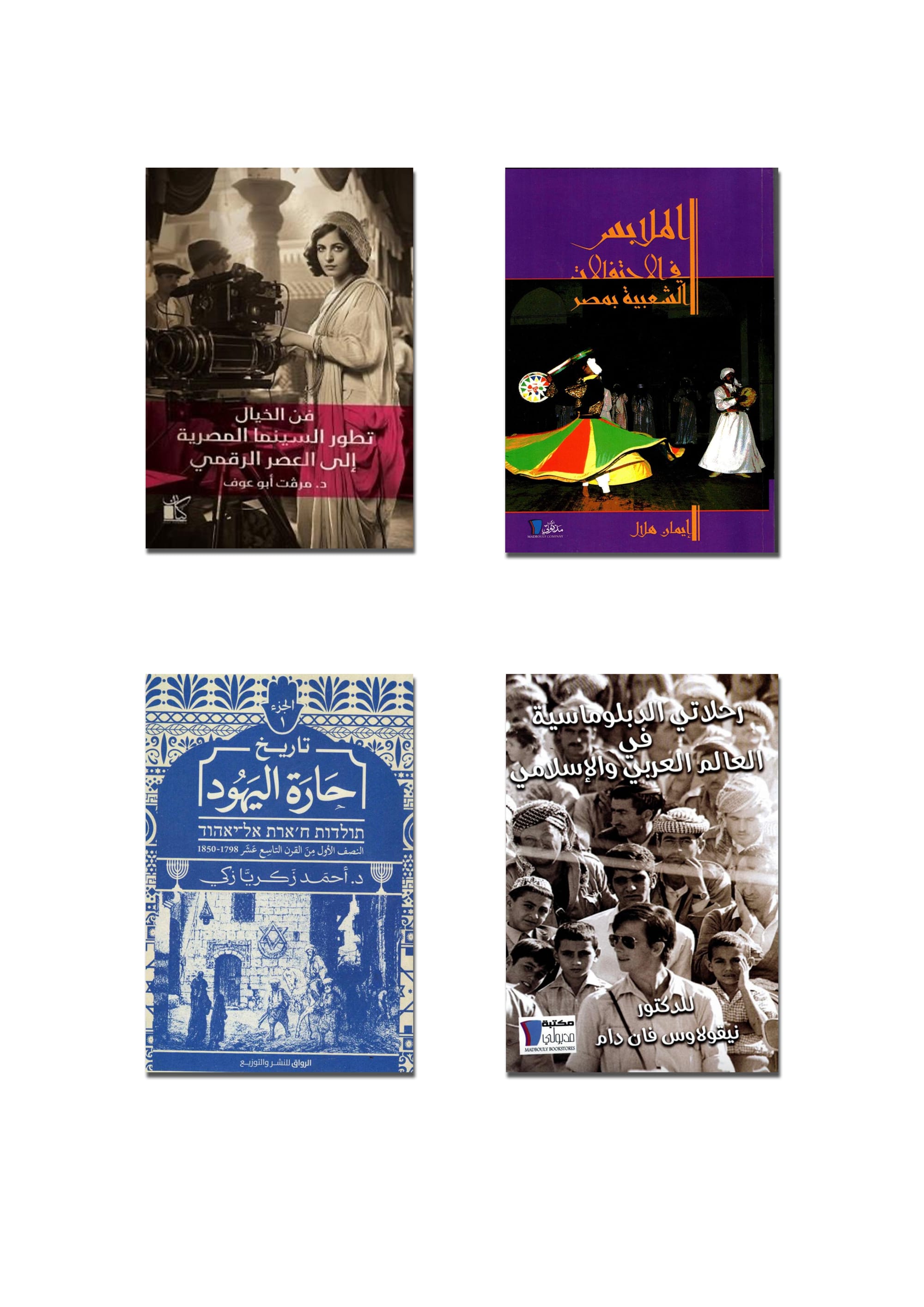
Imagining Cinema: The Evolution of Egyptian Film into the Digital Age
By: Mervat Abou Ouf
Published by: Kayan Publishing and Distribution
Publication: 2025
This is a rigorous and insightful book offering a comprehensive study of the development of Egyptian cinema, from its early beginnings in the 20th century to its contemporary transformations using digitisation and Artificial Intelligence.
The book traces back to 1917 as a pivotal starting point, then follows the evolution of the film industry as an integral part of Egypt’s national cultural identity, showing how the country emerged as a regional leader in Arab film production.
Imagining Cinema explores the historical, political, and social contexts that fostered the industry’s growth, paying particular attention to the founding of Studio Misr, the first major institutional cinematic project in the Arab world. It tracks the legal and regulatory milestones that shaped the industry, to understand the structural changes in Egyptian cinema.
The author draws on in-depth interviews with filmmakers, producers, distributors, and industry experts to assess the current state of Egyptian cinema and the challenges facing its growth and independence. These include government interference, bureaucracy, constraints on freedom of expression, monopolistic distribution networks, and digital piracy—which harms producers and undermines national revenue.
Pull Quote: Challenges facing Egyptian cinema include government interference, bureaucracy, constraints on freedom of expression, monopolistic distribution networks, and digital piracy
The book offers a critical reading of the legislative and regulatory developments shaping the Egyptian film industry, shedding light on the legal frameworks that govern it today, with special focus on constitutional articles related to freedom of expression and cultural autonomy. It also addresses the gaps in the system and the effect of profit-driven motives on content quality.
Furthermore, it explores the accelerating intersection between cinema and digital technologies—particularly AI and streaming platforms—demonstrating the opportunities and challenges they pose in redefining production, distribution, and audience engagement.
What distinguishes Imagining Cinema is its forward-looking approach to the evolving relationship between cinema and technology, the author analysing how tech innovations are reshaping the cinematic landscape.
Written with a keen eye, its blend of history, critique, and policy proposals make it an essential reference on a film industry long hailed as the ‘Hollywood of the East,’ reaffirming its cultural and economic significance in Egypt and the broader Arab region.
__
Clothing in Popular Celebrations in Egypt
By: Iman Hilal
Published by: Madbouly Publishing House
Publication: 2025
This is a rich, insightful book explores the relationship between popular rituals and dress, tracing the evolution of Egyptian celebrations from Pharaonic times to the modern era. A meticulous anthropological study, it shows the deep interconnection between clothing, custom, and ritual in Egyptian society across the ages.
Clothing in Popular Celebrations in Egypt offers a unique contribution to the cultural anthropology of Egyptian society, as it addresses a topic that has rarely received academic attention despite its symbolic and social importance. After all, clothing is a key element of identity, occasion, and ritual.
The author begins with age-old celebrations rooted in history, such as the Wafaa El-Nil (Flooding of the Nile Festival), showing how it transformed from a religious agricultural ritual into a national celebration that united Egyptians. Even foreign rulers sought to participate in it, to gain popular acceptance.
The book also highlights Sham El-Nessim (the Egyptian spring festival)—also known as Nowruz—and the traditional foods associated with it, which reflect the cultural continuity of Egyptian civilisation. These include specific food rituals like eating feseekh (salted fish), onions, and coloured eggs, along with traditional sweets.
Pull Quote: The book addresses a topic that has rarely received academic attention despite its symbolic and social importance. After all, clothing is a key element of identity, occasion, and ritual
One of the most significant religious and official spectacles was the Mahmal Procession, which served as a ‘bridge’ between Cairo (the political centre) and Mecca (the religious centre). A complex celebratory event, it featured Turkish cavalry and passed through areas like the Citadel, Al-Mahgar, and Al-Darb Al-Ahmar—making it a social ritual in which authority, religion, and popular culture intersected.
Looking at popular music, the book analyses various genres and instruments, dividing them into types. For instance, some are used for dhikr (a form of devotion) and religious praises (such as the Mevlevi Sufi music), while others are used for popular dances like tahtib (stick dancing), as well as mawwal (the sung poetry of Arabic music) and folk songs. All have contributed to transmission of local and historical narratives.
Still, the beating heart of the book is clothing, which is presented not merely as fashion but as a signifier—a marker of meaning. The author explores how the attire worn at Sbou (an infant naming ceremony) differs from that worn at weddings, henna nights, or Coptic baptism ceremonies.
She delves into the clothing of dervishes, devotees, magicians, and ghawazi (literally, ‘from Gaza’) dancers, reflecting Egypt’s vast cultural diversity, and traces the variations in bridal and groom attire across Lower Egypt, Upper Egypt, Sinai, and Nubia, showing how these garments express local traditions, gender roles, social class, and even family status. All in all, this is a fascinating read.
__
The History of the Jewish Quarter in the First Half of the 19th Century
By: Ahmed Zakaria Zaki
Published by: Al-Riwaq Publishing House
Publication: 2025
This book presents a meticulous and layered documentary study, drawing upon the accounts of travellers, Orientalists, and historians who visited Egypt and recorded their observations about the social, urban, and religious condition of the Jewish community in the 1800s.
The author begins with a pivotal historical moment: the French invasion to Egypt, when Napoleon’s fleet of 36,000 men landed in Alexandria in June 1798, then sought to win over Egypt’s Jews and Copts by exploiting sectarian and societal tensions.
The book explains how Jewish families’ living conditions were dire, owing to a long history of persecution and hardship (especially under Mamluk rule), which led some Jews to see the French occupation as a temporary refuge, even a chance for political inclusion.
The demographic structure of the Jewish Quarter was characterised by diversity, with two dominant sects: the Rabbanites, and the Karaites. Many worked in trades such as goldsmithing and money changing.
Architecturally, the Quarter was modest and overcrowded, but after the French withdrawal, Cairo witnessed rapid urban transformation, particularly under the rule of Muhammad Ali Pasha, who adopted a new policy toward the Jewish community based on tolerance and inclusion.
Pull Quote: Jewish families’ living conditions were dire, owing to a long history of persecution and hardship, so some saw the French occupation as a temporary refuge
By the mid-19th century, the number of Jews in Cairo had reached about 5,000, later increasing to 10,000 by 1850, as the Quarter expanded to include areas such as Abbassia, but the book also notes that most Jews preferred to remain within a “closed communal circle,” dedicating themselves to their economic and commercial roles, while avoiding political involvement.
During this period, the city’s Jews practiced their religious rituals freely through eight synagogues distributed across the Quarter, with additional waves of Jewish migration, including some from Jerusalem. Yet travellers’ accounts show that the Quarter was still marked poverty, poor health, and humble dwellings.
Interestingly, Ibrahim Pasha (Muhammad Ali’s son) was not only tolerant towards Egypt’s Jews but showed genuine respect for their religious and community leaders, offering them special protection.
The book stands out for its in-depth analysis of Muslim-Jewish relations during a transformative period in Egypt’s history. It provides valuable insights into the demographic, cultural, and architectural shifts in the heart of Cairo, contributing significantly to the study of sectarian and urban history during a critical time.
__
My Diplomatic Journeys in the Arab and Islamic World
By: Nikolaos van Dam
Published by: Madbouly Bookstore (Amr Madbouly)
Publication: 2025
Fresh out of university in Amsterdam, the author recalls how his research in the Arab world in the 1970s—including a thesis on Syria—unexpectedly led to him becoming a Dutch diplomat, and his experiences infuse this book, as does his analysis.
Now a seasoned envoy, Nicolaas van Dam invites readers into a richly layered narrative, mixing storytelling with sharp reflections and astute takeaways from his long journey through Iraq, Egypt, Turkey, and Indonesia.
He describes his post in Cairo in 1981 as “a dream job” for any researcher interested in Arab affairs. Working in the Middle East mission for the Presidency of the European Union, he met kings, princes, presidents, sheikhs, sultans, prime ministers, foreign ministers, and other officials.
In 1995, the first authorised Arabic edition of van Dam’s most famous book, The Struggle for Power in Syria, was published. He refused to have it censored beforehand and struck a deal with the renowned Madbouly Bookstore, whose owner was illiterate but who nevertheless possessed exceptional business acumen.
After five years of working in Cairo, van Dam moved to Turkey, which the Netherlands considered more important than Egypt. This surprised him, he recalls. It was the late 1990s, and Europe was discussing Turkey’s potential membership in the European Union.
In 1997, he submitted a report to the Dutch Foreign Ministry questioning whether Islam itself was an obstacle to Turkey joining the EU. “At the time, I believed Islam would not pose a barrier so long as Turkey maintained its strict secular system, which it still had then. But that situation has clearly changed since.”
Pull Quote: This is a richly layered narrative, mixing storytelling with sharp reflections and astute takeaways from the author’s long journey through Iraq, Egypt, Turkey, and Indonesia
The country in which van Dam most sought an appointment was Syria. It never happened, but at the end of 2014—more than four years after his retirement—he was unexpectedly appointed as a Special Envoy to Syria, based in Istanbul.
Maintaining relations with Syrian opposition voices took him to Moscow, Tehran, Riyadh, Ankara, Cairo, Geneva, Vienna, Beirut, Amman, Antakya, Gaziantep, Stockholm, and other cities. In his book, van Dam offers incisive thoughts on Europe’s approach to Syria, noting how moral and democratic ideals were prioritised over pragmatism and realpolitik.
Very few accepted the basic principle that only limited goals can be achieved in the absence of the necessary will and resources, he explains. Insisting on “ethical” or “politically correct” positions without being willing to provide the necessary resources to achieve them just prolonged a war that claimed over half a million lives, produced over 10 million refugees, and destroyed the country’s infrastructure.
While serious, the book does not lack amusing and insightful anecdotes and memorable concepts, including his “couscous border” through the middle of Libya dividing North Africa into a west and east, marked as much by dietary preferences as people’s demeanours.
From being confused with the Polish ambassador to being chased by Saddam Hussein’s security detail (when he found himself in a motorcade accompanying the Iraqi president on an unannounced visit to the nuclear facility), this is a memorable book packed full of memorable stories and thought-provoking observations.